
- June 18, 2025

Integrated Mine Closure Planning: Who Should Help Shape Post-Mining Transitions?
As mine closure practitioners, Okane advocates for integrated mine closure, recognizing that collaboration among stakeholders more comprehensively identifies risks and opportunities that can optimize post-mining transitions. In some jurisdictions, selective stakeholder and Indigenous rightsholder engagement during mine closure planning and implementation is a regulatory requirement, but it often lacks collaboration among the various stakeholders, Indigenous rightsholders, and subject matter experts, and the level of engagement and the degree to which input gets integrated is typically undefined.
Mine closure planning that uses established regulatory engagement requirements often results in the development of a transactional relationship, where the mining company is the focal point and engagement becomes a one-way street with limited scope. In contrast, meaningful engagement requires rethinking the process as a shared, collaborative effort. Recently, the International Council on Mining and Metals (ICMM) released the Handbook on Multistakeholder Approaches to Socio-Economic Transitions in Mining, which outlines what a multistakeholder process could look like when planning for mine closure. The handbook aims to transform the perception of mining from a transactional approach to a collaborative approach.
The ultimate goal of a multistakeholder approach to mine development and planning is to integrate socio-economic needs of all stakeholders and Indigenous rightsholders, allowing for equitable consideration in the development of closure planning goals. The ICMM handbook highlights the potential benefits mining companies could realize by adopting this collaborative and integrated approach (ICMM, 2025), including:
- addressing social and environmental challenges that may arise during closure, which could have cost implications;
- supporting efforts to meet closure and future land use objectives that contribute to a positive outcome and legacy among the community and shareholders;
- helping to facilitate future permitting processes by demonstrating commitments to responsible closure and land use transition planning; and
- creating opportunities for additional funding to support positive socio-economic outcomes during and post-mining land use transitions.
Integrated mine closure planning is a critical component of successful post-mining land use transitions, and comprehensive multistakeholder engagement is often a missed opportunity to support this success. In this month’s Conversation on Closure, we discuss the importance of integrated collaboration among stakeholders, Indigenous rightsholders, and other subject matter experts in supporting effective closure planning and contributing to successful post-mining land use transitions.
Collaboration for Effective Stakeholder Engagement
Each project is unique, and engagement requirements may vary across phases of the project lifecycle for different stakeholders and Indigenous rightsholder groups. In integrated mine closure planning, effective engagement begins by identifying relevant and impacted stakeholders, Indigenous rightsholders, and subject matter experts, and recognizing them as collaborators in developing closure and land use transition plans.
Typically, stakeholder engagement involves Indigenous rightsholders, as well as community and regulatory stakeholders. Additional stakeholders or groups that may also contribute to closure and land use transition planning include industry associations, faith-based organizations, academic and research institutions, healthcare groups, conservation groups, financial institutions (e.g., local credit unions), and private sector companies.
Identifying all stakeholders, Indigenous rightsholders, and subject matter experts early in the project lifecycle allows for early identification of risks and opportunities that can then be integrated through engagement efforts, ultimately enabling a greater chance at achieving successful closure planning and land use transitions. Failure to identify and classify these groups from the outset may result in poor communication of information and, ultimately, missed opportunity and risk identification.
Ongoing input and revisions to the engagement plan that capture the socio-economic needs of all stakeholders and integrate those needs into a single, unified plan will support a collaborative approach to closure and land use transition planning that is mutually beneficial to all parties involved.
Understanding the Project’s Risks and Opportunities
It is important to recognize that mine closure should not be considered an endpoint of the project lifecycle but rather a critical transition phase with significant environmental, social, and economic consequences. Effective collaboration in anticipation of this inevitable phase of the mining lifecycle requires a thorough understanding of the potential risks involved and the integration of diverse insights and perspectives to address these risks (Towards Sustainable Mining, 2021).
For example, two Australian iron ore mine sites currently approaching operational cessation are undergoing detailed engineering design closure studies. This involves evaluating landform closure strategies and conceptual design options using risk-based multi-criteria analysis. The closure vision set by the site owner outlines several key objectives:
- Relinquishing the site to the state government.
- Preserving and managing the land’s cultural heritage values of Traditional Owners and community members.
- Developing and implementing closure strategies that consider impacts on local communities.
- Achieving completion criteria co-developed with stakeholders and agreed upon with the state government.
- Designing landforms that are safe, stable, non-polluting, and compatible with the surrounding environment and intended post-mining land use.
- Achieving environmental outcomes aligned with the surrounding landscape.
- Implementing a workforce strategy that addresses the impacts of closure on employees and contractors.
- Achieving successful closure cost-effectively.
During stakeholder engagement sessions with state regulators in the design phase, it was identified that the steep terrain surrounding both sites could prevent some of the previously accepted conceptual landform closure strategies from meeting regulatory environmental objectives when the designs were being updated for improved constructability. The terrain complicates constructability and poses potential safety risks for operators working on steep or unstable slopes.
Other risks include the potential for surface water impacts from weathering mine materials, the proximity of closure landform footprints to creek lines and flood plains, additional disturbance to native vegetation and ecosystems during closure activities, ground stability concerns, and potential restricted access to culturally significant areas for community members and Indigenous rightsholders post-closure.
Identifying these risks presents an opportunity to develop a more suitable, integrated mine closure strategy and detailed closure designs. For instance, geotechnical engineers can modify landform designs to meet closure objectives while allowing safe access to important areas. Geoenvironmental consultants can design surface water management systems to control runoff and infiltration. Meanwhile, Traditional Knowledge holders and revegetation specialists can guide vegetation trials that promote soil stabilization and ecosystem recovery.
It is important to recognize that additional opportunities could have been captured if a more comprehensive, multistakeholder approach had been undertaken at the outset. The mining operations could have included (where relevant) specific engagement management plans involving local conservation groups, business associations, academic institutions, and community organizations, in addition to the regulatory bodies, local government, and Indigenous communities. These additional engagement sessions might have identified further opportunities for tailored closure strategies for specific post-mining land use, integrated educational opportunities throughout the project lifecycle, and established targeted conservation goals and post-mining transitional programs.
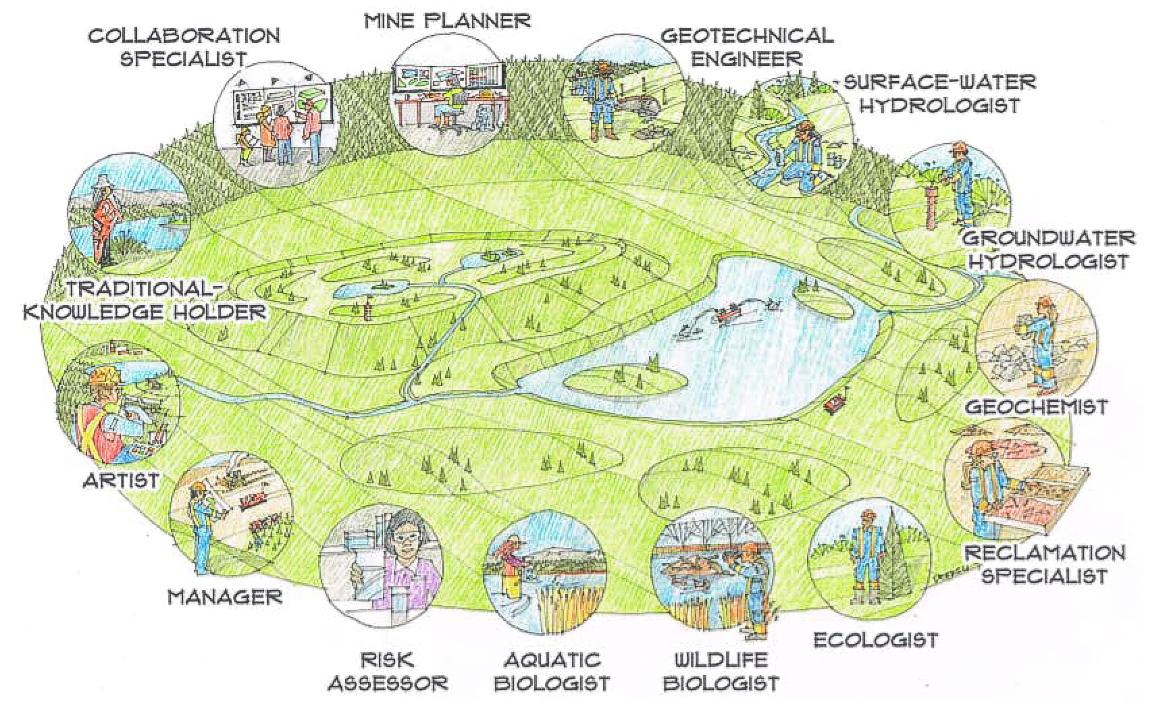
Note: Example of what integrated closure planning could look like involving various stakeholders and Indigenous rightsholders (Shuttleworth, 2021).
Okane’s Approach
At Okane, we facilitate collaborative workshops to achieve a unified closure vision for beneficial returning land use while mitigating operational risks. We consider Traditional Knowledge of land use, socio-economic considerations, and the site’s environmental context to inform our closure strategy.
Our Closure Vision and Stakeholder Engagement solution supports effective closure planning by fostering collaboration between operators, stakeholders, and Indigenous rightsholders, and developing objectives that are measurable, adaptable, and accountable. Through interdisciplinary collaboration, we create comprehensive strategies addressing technical, legal, environmental, and social aspects.
We support closure planning that allows multiple stakeholders and Indigenous rightsholders to explore diverse perspectives on potential post-closure economic uses. As the process moves toward execution and certainty in design, it becomes essential to foster collaboration so all parties can align on a shared vision.
Okane experts also serve on various Independent Tailings Review Boards, conduct due diligence assessments, closure readiness reviews, and evaluate closure liabilities. Our integrated approach promotes transparency, accountability, and reduced long-term liabilities while prioritizing sustainable outcomes for communities, ecosystems, and future land use.
From evaluating existing closure plans to developing new, practical, and responsible strategies, we support mining companies in navigating complex closure challenges while optimizing project value. To learn more, please contact us at info@okaneconsultants.com.
References
International Council on Mining and Metals (ICMM). (2025). Multistakeholder approaches to socio-economic transitions in mining. ICMM. https://www.icmm.com/website/publications/pdfs/social-performance/2025/guidance_multistakeholder-approaches.pdf?cb=107659
Shuttleworth, D. (Illustrator). (2021). Mining with the end in mind: Landform design for sustainable mining [Digital Illustration]. http://landformdesign.ca/LDI-PositionPaper2021.pdf.
Towards Sustainable Mining (TSM). (2021). Indigenous and Community Relationships Protocol. TSM. https://mining.ca/wp-content/uploads/dlm_uploads/2023/04/ICR-Protocol-English-2023.pdf