
Integrated Design Approach to Support Mine Closure Plan
Background
Discovered in 1871, Mount Bischoff was Tasmania’s first major mineral resource development, producing approximately 62,000 tonnes of tin from its open pit and underground operations (BMTJV, 2025). During BMTJV’s operations, mine rock extracted from the main pit was placed into the adjacent Happy Valley. Despite efforts to separate and contain potentially-acid generating materials, the Happy Valley Waste Rock Dump (HVWRD) has been generating acid and metalliferous drainage.
Approach
Okane was engaged to reimagine closure at the site by developing stable landforms that reduce the volume of contact water requiring treatment to meet regulatory requirements. This work resulted in an optimized landform plan that Okane is now advancing into a detailed closure design and execution strategy for the site’s Mine Closure Plan. We developed a geotechnically stable landform design based on available material volumes, and feasible construction and haulage strategies. Leveraging our Environmental Geochemistry and Water Stewardship expertise, we assessed geochemical conditions and developed water management systems to address both contact and non-contact water onsite. Additionally, due to the limited availability of non-acid generating material onsite, we identified potential borrow sources as material options and proposed a placement methodology to determine whether sufficient volumes are available for cover construction. We developed a haulage strategy considering the site’s steep terrain and estimated equipment hours in support of a project schedule and cost estimate.
Client Benefit
We developed a truly integrated, fit-for-purpose closure design package that utilizes available materials and an approach to manage the uncertainties associated with relocating the HVWRD into the main pit. Our approach to landform design integrated geochemical, geotechnical, water management, mine planning, cover systems and revegetation, with the closure design iteratively updated to reflect varying risk profiles. Ultimately, we developed an executable strategy for a closure plan, aligning with the closure vision and meeting the closure objectives of improving conditions in the receiving environment.
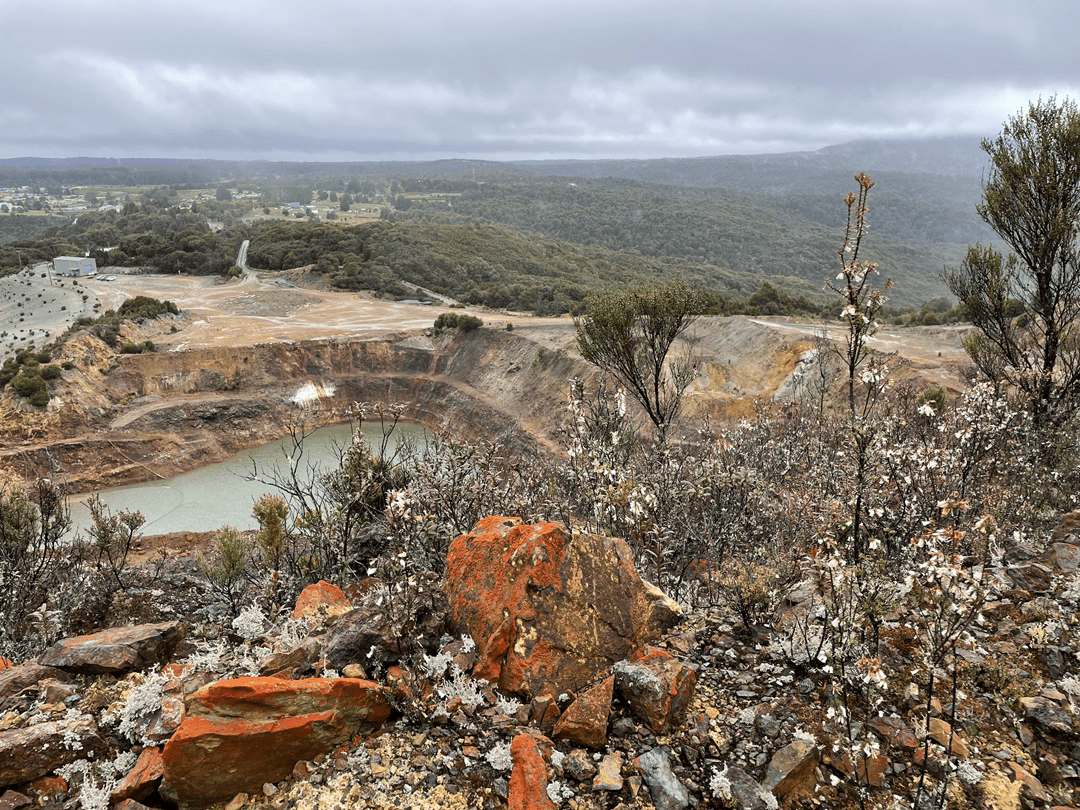
Overlooking Mount Bischoff [Digital Image]. Okane Archives.
Creating a stable landform that reduces the volume of contact water requiring treatment and meets regulatory requirements.
Solutions
Case Studies
Other Projects
1000-Year Landform Evolution
Northern Territory, Australia
Project: 1000-Year Landform Evolution
Learn More
A Cost Benefit Analysis (CBA) to Assess AMD Treatment Options
South Island, New Zealand
Project: A Cost Benefit Analysis (CBA) to Assess AMD Treatment Options
Learn More
A Cover Design Optimized for Haulage, Cost, and Revegetation
Western Australia, Australia
Project: A Cover Design Optimized for Haulage, Cost, and Revegetation
Learn More
A Cover System Model for Dry Stack Tailings
Atacama, Chile
Project: A Cover System Model for Dry Stack Tailings
Learn More
Acid and Metalliferous Drainage (AMD) Toolkit and Management Plan
Australia | Canada | Papau New Guinea
Project: Acid and Metalliferous Drainage (AMD) Toolkit and Management Plan
Learn More
Adjusting Covers for Climate Change
Idaho, USA
Project: Adjusting Covers for Climate Change
Learn MoreDiscuss This Case Study
Integrated Design Approach to Support Mine Closure Plan
Reach out to us at info@okaneconsultants.com for more information—we’d be happy to answer any questions you may have.
Let's Get In Touch